
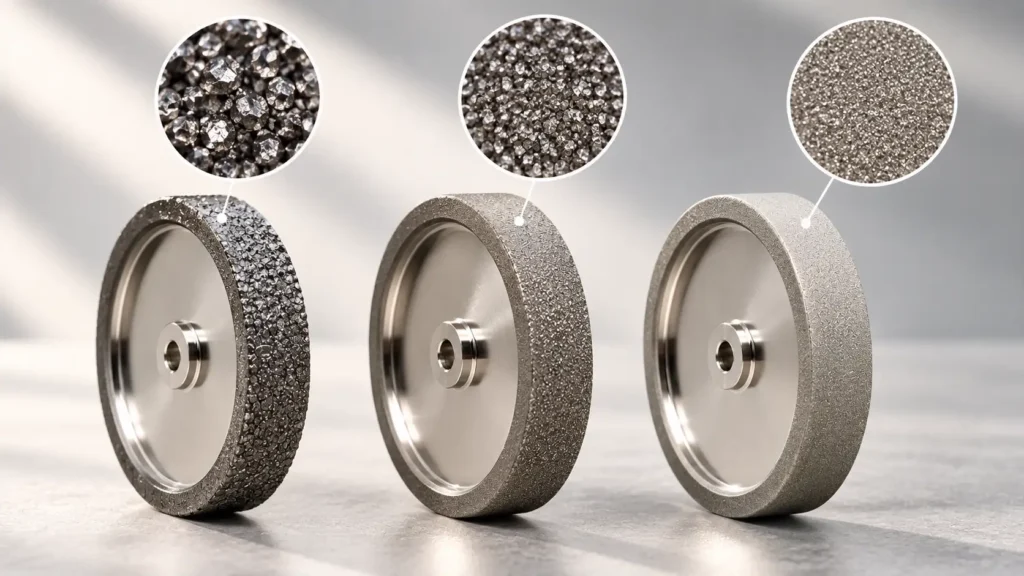
Choosing the right grit size is about finding the right balance between material removal and the desired surface finish. Larger abrasive grains generally provide a higher removal rate, while smaller particles are used when a finer and more even surface is required.
In industrial grinding, however, it is not enough to simply choose between coarse and fine grit. The material being machined, the choice between diamond and CBN, the contact area, the tool geometry, and the process settings all affect the result. Therefore, there is no universal grit size that is suitable for every application.
What is meant by grit size?
Grit size describes the size of the abrasive particles that perform the actual material removal. In diamond and CBN tools, these particles come into contact with the material and remove it.
The grit size affects how aggressively the material is machined. Larger particles are generally used when a relatively large amount of material needs to be removed. Smaller particles provide a lower removal rate but can help achieve a finer surface finish.
The principle is simple, but the choice must always be considered in relation to the specific operation.
Coarse or fine grinding – what is the difference?
In coarse grinding, the focus is often on removing material efficiently. As the component approaches its final dimensions, the requirements for precision and surface finish may become more important.
As a general rule of thumb:
| Choice | Typical effect |
|---|---|
| Larger abrasive grains | Higher material removal and a coarser surface finish |
| Smaller abrasive grains | Lower material removal and a finer surface finish |
This is a basic principle, not a ready-made recommendation. Two operations with the same requirements for the final surface may require different grit sizes if, for example, the material, geometry, or machine conditions differ.
The material affects the choice of grit size.
The first step is to understand the material being machined. Carbide, ceramics, and hardened ferrous materials have different properties and may therefore require different solutions.
The material also determines the choice between diamond and CBN. Diamond is primarily used for hard materials where iron is not the main constituent, such as carbide and ceramics. CBN, cubic boron nitride, is better suited to many ferrous materials, such as hardened steel.
If you have not yet decided which abrasive material is best suited to your application, you can read CBN or diamond – which tool should you choose?.
Once the workpiece material and abrasive material have been defined, it becomes easier to assess which grit size is suitable for the specific grinding operation.
How much material do you need to remove?
The next question is how much material the operation needs to remove.
If you need to remove a relatively large amount of material, larger abrasive grains may be suitable. If the operation is closer to finishing and the surface requirements are higher, smaller particles may be a better option.
In some processes, machining is carried out in several stages. An initial step is used for higher material removal, followed by finer machining to achieve the desired finish.
At the same time, this does not mean that more steps are always better. The process needs to be adapted to the component, the tolerances, and the specific production conditions.
Surface finish and precision need to be considered together.
A common simplification is to relate particle size solely to how smooth the surface becomes. Surface quality is important, but industrial grinding may also involve requirements for dimensions, profile, and form accuracy.
This is particularly evident when grinding with a custom-made tool designed to create or follow a specific geometry. In such cases, the grit size must work together with the tool geometry and the required level of precision.
A finer grit is therefore not automatically the solution to every surface-finish problem. Irregularities or scratches may also be caused by other aspects of the grinding process.
For a broader overview of materials, geometry, and process considerations, you can read How to choose the right grinding tool for your application.
The contact area affects how the tool performs.
The amount of the grinding surface that is in contact with the workpiece affects the conditions of the grinding process. A small contact zone and a large contact area do not create the same working conditions.
Geometry also plays a role. A profiled surface may involve different conditions than a simpler flat or cylindrical grinding operation.
This is an important reason why tables specifying a particular grit size for a certain material should be used with caution. The correct grit size is not determined by the material alone.
Grit size is only one part of the grinding process.
The machine and process parameters also affect what happens when the abrasive grains come into contact with the workpiece. Speed, feed rate, and any coolant used are examples of factors that can influence the result.
Therefore, if the same specification is used under two different process conditions, the result will not necessarily be the same.
When choosing the right grit size, you need to consider:
- the material to be processed
- the desired material removal rate
- requirements for surface finish and precision
- the choice between diamond and CBN
- contact area and geometry
- machine and process parameters
It is the interaction between these factors that determines how well the grinding process performs.
Does it matter how the abrasive grains are bonded?
Yes. Grit size tells you how large the abrasive particles are, but not how the entire tool is constructed.
In Diamantprofil’s electroplated diamond and CBN tools, the abrasive grains are attached to a metal body and held in place by a metallic bond. Part of the abrasive particles is exposed to the surface being machined.
This differs from abrasive products in which the particles are distributed throughout a larger volume of bonding material.
Read more about what an electroplated grinding tool is or explore Diamantprofil’s electroplated diamond and CBN tools.
How are different grit sizes specified?
There are different systems for specifying the size of abrasive particles. Therefore, it is important to know which classification system is being used before comparing different designations.
Many people are familiar with designations such as P80, P120, and similar grit ratings from conventional sandpaper and abrasive paper. These designations should not automatically be translated into specifications for industrial diamond or CBN tools.
The term grit is also used to describe the grading of abrasive particles, but the designation must be interpreted according to the classification system used for the specific product.
If an existing solution is to be replaced, it is therefore better to base the choice on the actual specification and the results achieved in the process rather than on a direct comparison with sandpaper.
When do you need to choose a different grit size?
A change in grit size may be appropriate when the balance between material removal and the final result is not right.
If the process removes too little material, a more aggressive specification may be one possible solution. If the surface is too coarse, a finer grit size may need to be considered.
However, before changing the specification, the rest of the process should be checked. An unexpected result may also be caused by factors such as feed rate, speed, wear, or other process conditions.
It is therefore better to start with the actual problem rather than automatically changing the grit size.
How to choose the right grit size for your application
Before starting a new grinding operation, you should define what the process is intended to achieve.
Start with the material. Then determine how much material needs to be removed and what requirements apply to the finished surface, dimensions, and geometry. The choice of grit size can then be considered in relation to diamond or CBN, the contact area, and the machine conditions.
If you already have a process that works, the existing specification provides a valuable point of reference. If the result needs to be changed, you can then assess which parameter should be adjusted instead of changing several things at the same time.
For applications where diamond is the right abrasive material, you can read more about diamond grinding wheels and their applications.
Do you need help choosing the right option?
There is no single grit size that automatically delivers the best result for every grinding operation. The material, removal rate, desired surface finish, geometry, and process conditions all need to be considered together.
Diamantprofil develops customized diamond and CBN solutions for industrial applications. If you have a drawing, an existing tool specification, or information about the operation, you can contact Diamantprofil to discuss the requirements.
Frequently asked questions about grit size in grinding
What does grit size mean in grinding?
It describes the size of the abrasive particles that machine the material. The grit size affects, among other things, the material removal rate and the surface finish that can be achieved.
Do larger abrasive grains always result in faster grinding?
Larger particles generally provide a higher material removal rate, but that does not mean they always deliver the best result. The material, contact area, machine, and other process parameters all affect how efficiently the grinding process can be carried out.
When should finer abrasive grains be used?
Finer abrasive grains are typically used when a better surface finish is required and a lower material removal rate can be accepted. At the same time, the choice needs to be adapted to the material and the specific grinding operation.
Is grit the same as grit size?
Grit is used to describe the grading of abrasive particles. However, different classification systems are used, which means the designation must be interpreted according to the standard or specification that applies to the product.
Are P80 and P120 the correct designations for diamond tools?
P-designations are commonly associated with products such as sandpaper, but they should not automatically be applied to diamond and CBN tools. Check which grading system is used before comparing different designations.
Does the choice affect the tool's service life?
Particle size is one of several factors that affect how the tool performs and wears. Tool life is also influenced by the material, contact area, process parameters, and how the tool is used.


 English
  Swedish