
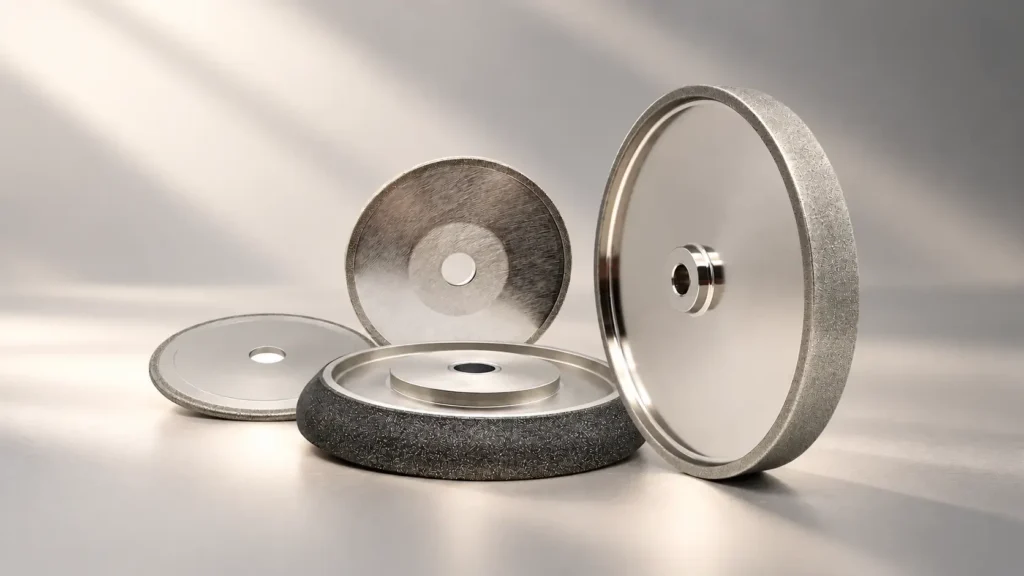
An electroplated grinding tool has diamond or CBN grains attached to a metal body by means of a thin metallic coating. This design makes it possible to position the abrasive grains on a defined surface and manufacture tools in both simple and complex shapes.
The technology is used in industrial metalworking and other applications where the material, geometry, and precision requirements determine how the tool needs to be designed. At Diamantprofil, the shape and size can be customized to suit the workpiece being processed.
How Does Electroplating of Diamond and CBN Tools Work?
Electroplating is an electrochemical process. In simple terms, an electric current is used to deposit metal ions from an electrolyte bath onto an electrically conductive substrate.
In the manufacture of diamond and CBN tools, the process is used to anchor the abrasive grains to a metal body. Nickel acts as the bonding metal around part of each grain, while a portion of the grain remains exposed so that it can engage with the material being processed.
The build-up of the coating needs to be carefully controlled during manufacturing. Among other factors, the thickness of the coating affects how securely the grains are held in place and how much of each grain remains exposed.
The term galvanizing is sometimes used broadly to refer to electrochemical plating, but zinc coating for corrosion protection serves a different purpose. In a diamond or CBN tool, the process is used to bond the abrasive grains to the tool body.
Three Components That Together Form the Tool
The construction can be simplified into three main components: a tool body, a metallic bond, and the abrasive grains themselves.
The tool body determines the basic shape and dimensions. Diamantprofil uses steel tool bodies, and the geometry can be customized to meet the customer’s requirements.
The bond holds the grains in place. Unlike designs where abrasive particles are distributed throughout a thicker bonding material, the grains here are concentrated on the active surface.
Diamond or CBN performs the actual material removal. Which material is most suitable depends primarily on what is being processed.
This design provides a high degree of flexibility when the active surface needs to follow a profile, radius, or other specific geometry.
More information about Diamantprofil’s different tool designs is available on the page about diamond and CBN tools.
Diamond or CBN – What Is the Difference?
The manufacturing method does not determine which abrasive material should be used. That choice is based on the workpiece material and the process conditions.
Diamond is primarily used for hard materials where iron is not the main constituent, such as carbide and ceramics. CBN, cubic boron nitride, is better suited to many ferrous materials, such as hardened steel, tool steel, and cast iron.
It is therefore important to distinguish between two decisions: how the tool should be designed and which abrasive material is best suited to the workpiece.
If you would like to learn more about material selection, read our guide CBN or Diamond – Which Tool Should You Choose?.
This article explains the tool construction itself. If you instead want to evaluate the overall selection based on material, grit size, geometry, and desired finish, read How to Choose the Right Grinding Tool for Your Application.
Internally link the bold text to the September article once its published URL has been finalized.
What Properties Does This Design Provide?
A key characteristic is that the abrasive grains are exposed on the active surface. This means they do not first need to be released from a larger amount of bonding material before coming into contact with the workpiece.
At the same time, the tool body can be designed to suit the specific machining operation. This makes it possible to create profiles and geometries that may be difficult to achieve with a standard tool design.
This can be relevant when:
- a specific profile needs to be machined
- the workpiece has a complex geometry
- high form accuracy and precision are required
- only a specific part of the tool body needs to be coated
- a standard tool is not suitable for the specific operation
This does not mean that this design is always the right choice. The material, machine, desired finish, material removal rate, and other process conditions still need to be considered together.
Common Applications
The requirements range from relatively simple grinding wheels to special-purpose tools with geometries developed for a specific workpiece.
Diamantprofil develops solutions for materials including carbide and hardened steel, as well as tools for applications where a specific profile needs to be machined. The choice between diamond and CBN allows the technology to be used for different material groups.
A custom design becomes particularly relevant when selecting only the dimensions and grit size from a standard range is not sufficient. In such cases, the process can instead begin with a drawing of the finished workpiece or of the tool required for the operation.
This makes it possible to take the geometry into account from the very beginning when designing the tool body.
Grit Size Is Still Important
The manufacturing method is only one part of the specification. The size of the abrasive grains also affects how the machining process is carried out.
Coarser grits generally provide higher material removal rates and a rougher surface. Finer grits are used when a finer finish is required. At the same time, the result is also influenced by factors such as the machine, speed, feed rate, and other process conditions.
The right grit therefore needs to be selected together with the material, geometry, and requirements for the final result.
We cover this topic in more detail in the upcoming guide Which Grit Size Should You Choose for Grinding? The link will be added once the article has been published.
How Long Does a Diamond or CBN Tool Last?
It is not possible to specify a general tool life based solely on the manufacturing method. Wear is influenced by factors including the material being processed, grit selection, contact area, and how the process is run.
However, once the active surface is worn out, the entire tool does not always need to be replaced.
If the steel tool body is still in sufficiently good condition, it can often be reused. Diamantprofil offers recoating of diamond and CBN tools, where the old abrasive surface is removed and the tool body is given a new layer of abrasive grains.
This can extend the service life of the tool body itself and is particularly valuable for special-purpose tools where significant work has gone into developing a specific geometry.
Whether recoating is possible, however, needs to be assessed based on the condition and design of the tool body.
When Is a Custom Tool Relevant?
Standard products are sufficient for many operations. However, when requirements for profile, accessibility, or form accuracy become more specific, it may be better to start with the workpiece and the process.
Diamantprofil states that a large proportion of its production consists of custom special-purpose tools. The basis for the design can, for example, be a drawing of the finished workpiece or the desired tool configuration.
This makes the questions more specific: What material is to be processed? What profile is required? Where should the active surface be located? What are the requirements for precision and the final result?
Based on this, the geometry, abrasive material, and other specifications can be determined.
Do You Need a Solution for a Specific Machining Operation?
The advantages of the technology become particularly clear when the shape of the tool needs to be adapted to the workpiece being produced. However, the tool design is only one part of the selection process. The material, grit, geometry, and process conditions all need to work together.
If you have a drawing, an existing tool, or an operation that requires a custom solution, you can contact Diamantprofil to discuss your requirements.
Frequently Asked Questions About Electroplated Diamond and CBN Tools
What Does Electroplated Mean?
It means that a metallic layer is deposited onto an electrically conductive surface through an electrochemical process. In this type of tool, the process is used to anchor diamond or CBN grains to the tool body.
Why Is Nickel Used?
Nickel can be used as the metallic bond that holds the abrasive grains to the tool body. Part of each grain remains exposed so that it can engage with the material being processed.
What Is the Difference Between Diamond and CBN?
Diamond is used for materials such as carbide and ceramics. CBN is primarily used for ferrous materials such as hardened steel. The right choice depends on the material being processed and the specific process.
Can the Tool Be Recoated?
In many cases, yes. If the tool body is still in good condition, the old abrasive surface can be removed and a new one applied. Whether recoating is possible needs to be assessed based on the condition of the specific tool.
Can Diamantprofil Manufacture Tools from a Drawing?
Yes. Diamantprofil states that custom special-purpose tools can be developed based, for example, on a drawing of the finished workpiece or the desired tool.


 English
  Swedish