
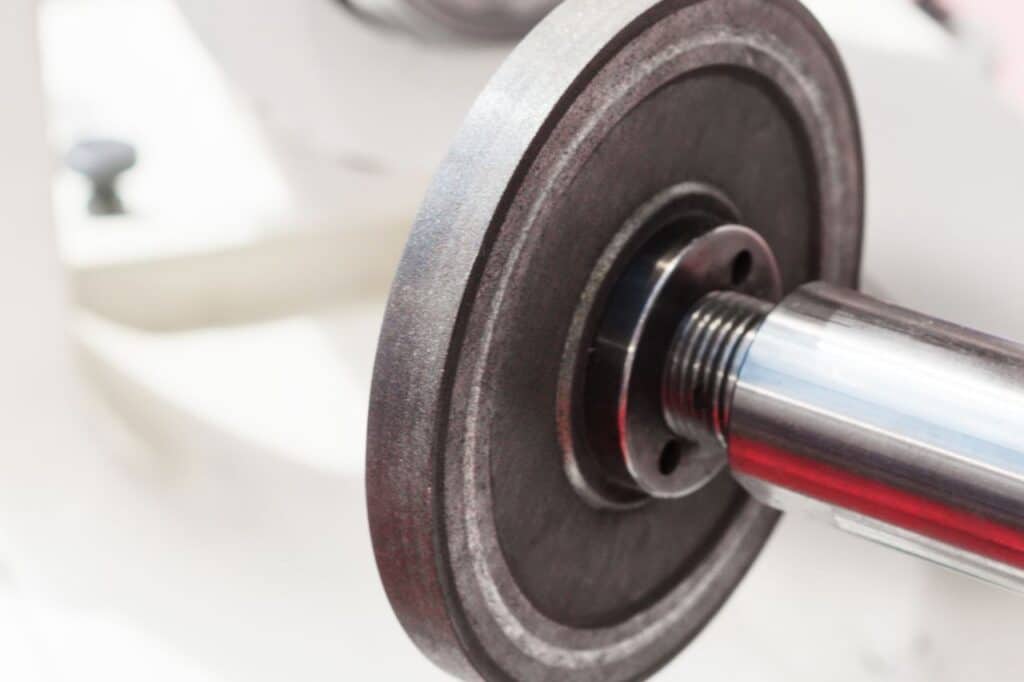
Diamond grinding wheels are used for grinding very hard materials and in applications where high demands are placed on precision and surface finish. They are used, among other things, for carbide and technical ceramics, but the right solution must always be selected based on the material, the geometry of the component, and the specific grinding process.
Another important consideration is which abrasive material is suitable for the workpiece. For many ferrous materials, CBN is a more suitable alternative. The grit size, tool design, and process parameters also affect the final result.
What are diamond grinding wheels?
Diamond grinding wheels are abrasive tools in which diamond grains provide the cutting action. As the wheel rotates, the exposed grains come into contact with the workpiece and remove material.
Diamond has a very high hardness and is therefore well suited to demanding grinding operations in materials such as carbide. In industrial manufacturing, synthetic diamond is used, making it possible to produce abrasive materials with properties tailored to different applications.
How the grains are held in place depends on the tool design. Diamantprofil works with electroplated tools, where the abrasive grains are anchored to a metal body using a metallic bond.
If you would like to learn more about the principle behind the design, you can read what an electroplated grinding tool is.
Why is diamond used as an abrasive?
Its high hardness and wear resistance make diamond useful when conventional abrasives do not provide the desired result.
For the right application, diamond grinding wheels can combine efficient material removal with high requirements for precision and surface quality. The tool body can also be designed to match the geometry that needs to be ground.
This does not mean that the same design will deliver maximum performance in every situation. The workpiece material, abrasive grains, contact area, wheel design, and process settings all need to work together.
Which materials are diamond grinding wheels suitable for?
Diamond grinding wheels are primarily used for very hard materials where iron is not the main constituent. Carbide and technical ceramics are two important examples.
Carbide
Carbide combines high hardness with good wear resistance and can be demanding to grind using conventional grinding wheels. Diamond is therefore a common choice when carbide components need to be shaped or finished.
The most suitable design depends, among other things, on the geometry of the component, the desired material removal rate, and the requirements for the final surface finish.
Technical ceramics
Technical ceramics can also be ground using diamond tools. The properties of the material mean that both the tool and the grinding process need to be adapted to the specific operation.
Here, it is particularly important to consider the process as a whole. The abrasive material is only one of several factors that affect the result.
Glass and other suitable materials
Diamond can also be used for glass and other hard, brittle materials. The most suitable solution depends on the properties of the material and what the grinding operation is intended to achieve.
The product should therefore be specified based on the actual application rather than solely on the hardness of the material.
How is an electroplated diamond grinding wheel constructed?
In an electroplated design, the abrasive grains are anchored to a shaped metal body. This construction differs from products in which the abrasive particles are distributed throughout a larger volume of bonding material.
The grains are exposed on the active surface, while the shape of the tool body can be adapted to the geometry being ground.
This makes it possible to manufacture both relatively simple grinding wheels and custom tools with profiles designed for a specific component.
Diamantprofil manufactures electroplated diamond and CBN tools in various designs and can adapt the shape and size to the specific grinding operation.
Grit size affects material removal and surface finish
The size of the abrasive grains affects how diamond grinding wheels perform. Larger grains generally provide a higher material removal rate and a coarser surface finish. Smaller particles are used when a finer finish is required and a lower material removal rate can be accepted.
However, this relationship is only a starting point. The contact area, feed rate, workpiece material, and other process conditions also affect the result.
Grit size should therefore be selected together with the rest of the specification. In our guide on which grit size to choose for grinding, we go through the most important factors.
Common applications for diamond grinding wheels
Diamond grinding wheels can be used for several types of industrial grinding operations. The exact application depends on the shape and specification of the wheel, as well as the material being ground.
Common applications include, for example:
- grinding of carbide
- grinding of technical ceramics
- profile grinding
- working with glass and other suitable hard materials
- operations where a specific geometry needs to be created or followed
- processes with high requirements for repeatable results
For profiled components, the geometry of the tool body can be just as important as the abrasive material itself. A customized design makes it possible to start from the component and adapt the active surface to the required shape.
Diamond grinding wheel for concrete – is it the same type of tool?
Searches for diamond grinding wheels often return products intended for concrete, granite, and marble. These also use diamond, but their construction and applications differ from the precision tools that Diamantprofil works with.
A diamond grinding wheel for concrete may, for example, be designed for removing or leveling concrete surfaces using handheld machines or floor grinding equipment.
Diamantprofil’s electroplated products, on the other hand, are designed for industrial applications and customized solutions for materials such as carbide.
It is therefore important not to choose a diamond wheel based on the name alone. The tool design, machine, and intended application must be suitable for the specific process.
When is CBN a better alternative?
For many ferrous materials, CBN, cubic boron nitride, is a more suitable abrasive material. Hardened steels are one example.
A simplified guideline is:
| Workpiece material | Common choice |
|---|---|
| Carbide | Diamond |
| Technical ceramics | Diamond |
| Glass | Diamond |
| Hardened ferrous materials | CBN |
| Tool steel | CBN |
The table is intended as a guide and does not replace an assessment of the specific process.
For a more detailed comparison, you can read CBN or diamond – which tool should you choose?. You can also read about CBN grinding wheels and when CBN is the right choice.
Speed and other process parameters
The right grinding wheel is only one part of a successful process. Rotational speed, feed rate, contact area, and any coolant used all affect how the tool performs and wears.
Permissible rotational speeds and peripheral speeds must comply with the specifications for the specific product and machine. There is therefore no universal RPM value or number of metres per second that is correct for all diamond grinding wheels.
Incorrect process conditions can, among other things, contribute to overheating and poorer results. The settings therefore need to be adapted to both the tool and the specific operation.
How long do diamond grinding wheels last?
It is not possible to specify a general service life. Wear is affected by the workpiece material, contact area, abrasive grains, feed rate, and how the product is used.
For electroplated tools, it may also be possible in some cases to reuse the tool body once the active surface has worn out.
Diamantprofil offers replating of diamond and CBN tools. If the tool body is in suitable condition, the old coating can be removed and a new abrasive surface applied.
This is particularly beneficial for custom-made special tools where the tool body has been manufactured with a specific geometry.
How to choose the right diamond grinding wheel for your application
Start with the component and the process rather than focusing solely on the dimensions of the grinding wheel. A good specification should answer:
- What material is to be ground?
- How much material needs to be removed?
- What are the requirements for surface finish and dimensional accuracy?
- What geometry needs to be created or followed?
- What grit size is suitable for the task?
- What are the machine and process conditions?
If the workpiece material is ferrous, you should also assess whether CBN is a more suitable alternative.
For a broader overview of the selection process, you can read how to choose the right grinding tool for your application.
Customized solutions for specific applications
Standard products are suitable for many operations. When the component has a specific profile or when high form accuracy is required, a customized grinding tool may be more appropriate.
Diamantprofil develops custom tools where the shape and size can be adapted in collaboration with the customer. The starting point may, for example, be a drawing of the component or an existing tool.
In this way, the geometry of the tool body, the active surface, and the abrasive properties can be assessed as parts of the same solution.
If you have a component, drawing, or grinding operation that you would like to discuss, you can contact Diamantprofil.
Frequently asked questions about diamond grinding wheels
Which materials can be ground with diamond?
Diamond is primarily used for hard materials where iron is not the main constituent. Carbide, technical ceramics, and glass are examples. The final specification needs to be adapted to the material and the grinding process.
Can diamond be used for hardened steel?
For hardened ferrous materials, CBN is generally a more suitable alternative. The workpiece material should therefore be identified before the grinding tool is specified.
What is the difference compared with a conventional grinding wheel?
The difference lies, among other things, in the abrasive material and the construction. Diamond grinding wheels use diamond as the abrasive material, while conventional products may, for example, use aluminium oxide or silicon carbide.
Which grit size should I choose?
It depends on the desired material removal rate, surface finish requirements, workpiece material, and process conditions. Larger particles generally provide higher material removal, while smaller particles are used for finer grinding.
Is a diamond grinding wheel the same as a diamond cutting wheel?
No. Grinding and cutting are different operations, and the tools are designed for different purposes. The product should always be intended and specified for the specific process.
Can an electroplated grinding wheel be replated?
In many cases, the tool body can be reused if it is still in sufficiently good condition. The old coating is then removed and a new active surface is applied. The specific tool needs to be assessed before replating.


 English
  Swedish