
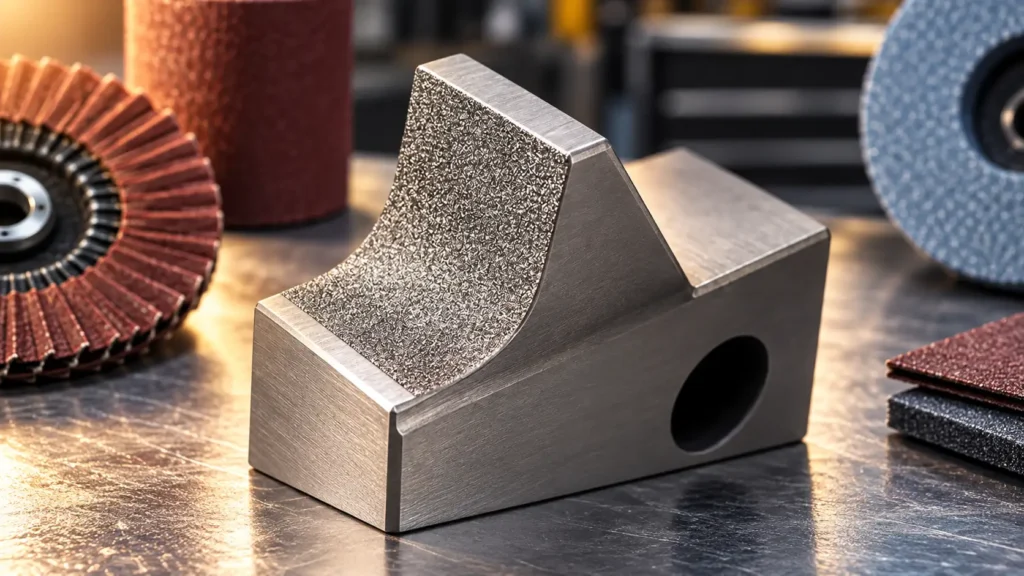
Choosing the right grinding tool starts with the material to be processed and the result you want to achieve. High material removal places different demands on the tool than a process where precision and a smooth finish are the main priorities. Geometry, abrasive type, and grit size also influence which option is best suited to the application.
For industrial grinding, there is rarely a single solution that works equally well in every application. By first defining the material, the geometry of the workpiece, and the requirements for the final result, it becomes easier to select the right tool for the specific application.
Choose the Grinding Tool Based on the Material to Be Processed
The material is a natural starting point. What works well for carbide may not necessarily be the right choice for hardened steel.
Diamond is primarily used for hard materials where iron is not the main constituent, such as carbide and ceramics. CBN, cubic boron nitride, is better suited to many ferrous materials, including hardened steels, other suitable steel grades, and cast iron.
The difference is not only about hardness. The properties of the material and the processing conditions need to be considered together before making a selection.
As an initial guideline:
- carbide and ceramics: usually diamond
- hardened ferrous materials: usually CBN
- cast iron: CBN may be suitable depending on the machining process
For a more detailed guide to material selection, read CBN or Diamond – Which Tool Should You Choose?.
What Should the Grinding Process Achieve?
Two grinding operations on the same material can have completely different objectives. In rough grinding, a high material removal rate may be the priority. In other cases, the focus may be on dimensional accuracy, precision, or achieving a specific surface finish.
Therefore, start with the requirements for the finished workpiece rather than with a specific grinding wheel.
A few questions can help you define the requirements:
- How much material needs to be removed?
- How fine does the finished surface need to be?
- Are there tight tolerances?
- Does a specific shape, profile, or radius need to be created?
- What does the contact area look like during grinding?
- Does the result need to be consistently repeatable in a production run?
The answers provide a better basis for selecting the right grinding tool than simply considering factors such as diameter or grit size.
Choose the Right Abrasive – Diamond or CBN
Diamond and CBN are both very hard abrasives, but their properties make them suitable for different materials.
Diamond is used for machining materials such as carbide and ceramics. CBN is better suited to many ferrous materials. The hardest option is therefore not automatically the best choice. The material to be processed must be a key factor in the selection.
Diamantprofil uses both materials in its electroplated diamond and CBN tools. The shape and size can be adapted to the specific operation, which is particularly relevant when the process requires a specific profile or other geometry.
If you would like to learn more about the design itself, you can also read the guide What Is an Electroplated Grinding Tool?.
The Right Grit Size Depends on the Desired Finish
Once the abrasive material has been selected, the grit size also needs to be matched to the task.
In general, coarser grits provide higher material removal rates and a rougher surface. Finer grits are used when the requirements for the final finish are higher.
However, this relationship cannot be considered in isolation from the rest of the process. Machine characteristics, speed, feed rate, cooling, and the contact with the workpiece also affect the result.
Choosing the right grit size is therefore about finding a balance between material removal, precision, and the desired finish. In our guide on which grit size to choose for grinding, we take a closer look at the factors that influence the selection.
The Geometry Must Suit the Application
Abrasive material and grit size are not the only factors to consider. The shape can be just as important when machining a specific profile, radius, or hard-to-reach surface.
This is particularly evident in industrial metalworking, where standardized solutions do not always match the geometry of the workpiece or the requirements of the process.
Diamantprofil can design the shape and size of its electroplated diamond and CBN solutions together with the customer. This makes it possible to start from the workpiece and the actual operation, rather than trying to adapt the process to an existing standard design.
Customization may be relevant, for example, when:
- the workpiece has a specific profile
- high form accuracy is required
- a surface is difficult to access
- a standard design does not suit the process
- the coated section needs to be adapted to the machining operation
A drawing, together with information about the material and process, provides a concrete basis for evaluating possible solutions.
Look at the Entire Grinding Process – Not Just the Grinding Wheel
Even a well-specified grinding tool is only one part of the overall process. Machine characteristics, rotational speed, feed rate, cooling, and contact with the workpiece can all affect both the result and tool life.
If the grinding process does not perform as intended, the solution is not necessarily to change a single parameter. A surface finish problem, for example, may be caused by several interacting factors.
It is better to evaluate the process as a whole. Is diamond or CBN suitable for the material? Is the geometry appropriate? Is the process stable? Do the machine and process parameters match the required material removal rate and surface finish?
This perspective is particularly important in industrial applications where the result needs to remain consistent and repeatable over time.
When Is a Custom Grinding Tool Needed?
Standard grinding wheels work well for many applications. However, when the requirements for profile, accessibility, or form accuracy become more specific, a custom-designed tool may be a better option.
The requirements may relate to the diameter, profile, shape, or which part of the tool needs to be coated. In other cases, the starting point may be a specific production problem where an existing solution does not deliver the desired result.
Diamantprofil manufactures custom electroplated diamond and CBN tools for industrial applications. The basis for the design can, for example, be a drawing of the workpiece or the desired tool configuration.
It is also worth considering what happens when the active surface is worn out. A steel body does not always need to be discarded. Depending on its design and condition, it may be reused through recoating of diamond and CBN tools.
Six Questions to Help You Choose the Right Tool
When compiling the requirements, you can start with six questions:
- What material is being processed?
The material provides an initial indication of whether diamond or CBN is the better choice. - How much material needs to be removed?
Rough grinding and finishing place different demands on the tool. - What final result is required?
Consider tolerances, precision, shape, and the desired surface finish. - What grit size is suitable?
The grit size needs to be balanced against material removal and the required finish. - What geometry is required?
Determine whether a standard design is sufficient or whether a custom solution is needed. - What are the process conditions?
Machine characteristics, speed, feed rate, cooling, and other parameters need to be taken into account.
When these questions are considered together, you get a better basis for decision-making than if a single characteristic is allowed to determine the entire choice.
Need Help Choosing the Right Grinding Tool?
For a simple operation, the selection may be relatively straightforward. As the material, geometry, and production requirements become more specific, more parameters need to be considered together.
Diamantprofil Europe AB works with electroplated diamond and CBN solutions for industrial applications and can base the solution on, for example, a drawing, an existing design, or the production conditions.
Do you have a workpiece, drawing, or grinding operation you would like to discuss? Contact Diamantprofil to discuss your requirements.
Common Questions About Grinding Tools
Which Grinding Tool Is Suitable for Hardened Steel?
CBN is usually a suitable option for hardened steel and other suitable ferrous materials. The final specification also depends on the material properties, the geometry of the workpiece, and the requirements for the finished result.
When Is Diamond Used for Grinding?
Diamond is primarily used for hard materials where iron is not the main constituent, such as carbide and ceramics. For many ferrous materials, CBN is a more suitable option.
How Do You Choose the Right Grit Size?
Base the selection on how much material needs to be removed and the surface finish that needs to be achieved. Larger abrasive grains generally provide higher material removal rates, while smaller grains are used for finer finishing. The machine and other process parameters also affect the result.
What Is an Electroplated Grinding Tool?
It is a type of grinding tool in which diamond or CBN grains are bonded to a metal body by means of a metallic coating. This design makes it possible to combine a defined abrasive surface with a variety of shapes and dimensions.
Can Diamantprofil Manufacture Tools from a Drawing?
Yes. Diamantprofil works with customized special tools, where a drawing of the workpiece or the desired tool design can be used as the basis for development.


 English
  Swedish